Field Notes
FCC Adds Foreign-Produced Connected Power Inverters to Covered List
The FCC has restricted new foreign-produced connected power inverter models. Here is what changed and what U.S. solar installers should do now.

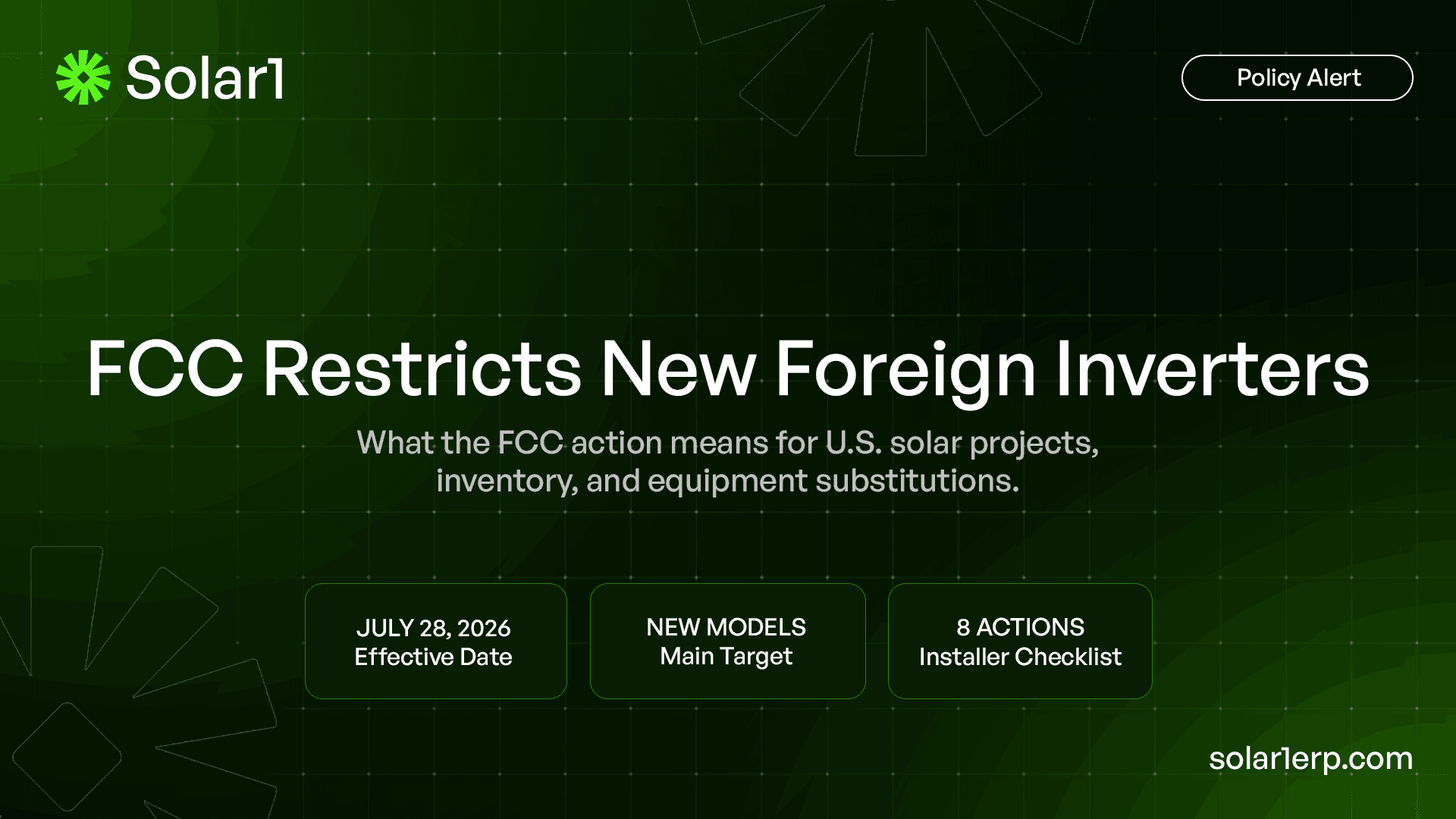
Status as of July 31, 2026: The FCC has added foreign-produced connected power inverters to its Covered List. The immediate restriction applies to new models that had not already been released or authorized. It does not automatically remove every installed system or prohibit every previously authorized model.
The headline is real. The operational meaning is narrower than “all foreign solar inverters are now illegal.”
On July 28, 2026, the Federal Communications Commission released measures covering connected power inverters used with renewable energy, battery systems, grids, and data-center equipment. Reuters reported that the measures took effect upon publication, are aimed mainly at Chinese products, and apply to new models not yet released.
That creates a new procurement and compliance problem for U.S. solar installers. The risk is not only whether an inverter can be purchased. A model change can affect the approved design, permit set, utility application, project budget, field plan, monitoring setup, customer agreement, and warranty record.
What exactly did the FCC change?
The FCC updated its Covered List to include connected power inverters produced in foreign countries. Equipment on the Covered List generally cannot receive the FCC authorization required for new covered models to be imported or sold in the United States.
Reuters reported that the action went into effect when published. It also reported that the immediate restriction applies to inverter models that had not yet been released and that many non-Chinese suppliers are expected to receive exemptions.
The action is therefore broader in wording than a China-only headline, but its practical target is currently Chinese equipment. Installers should not assume every non-U.S. inverter is prohibited. They should verify the exact model, authorization status, manufacturer position, and any applicable exemption.
The FCC also retains authority to revoke existing authorizations. That is important, but it is not the same as saying every previously approved model has already been revoked.
What the action does and does not mean
The first job is to separate the confirmed rule from the conclusions people may draw from it.
A model that was never released is different from a model already authorized, stocked, installed, or operating under warranty. Those project states should not be mixed together.
A public headline may say “effective immediately.” For an installer, the useful question is: effective immediately for which model, under which authorization, at which stage of the project?
| Common claim | More accurate reading | Installer response |
|---|---|---|
| All foreign solar inverters are banned | The Covered List wording covers foreign-produced connected power inverters, while Reuters reports the immediate target is mainly Chinese products and exemptions are expected | Verify the exact model and exemption status |
| Installed systems must be removed | The immediate action applies to new unreleased models and does not order blanket removal of installed equipment | Do not replace without model-specific evidence |
| Effective immediately means every current sale stops | The measure took effect upon publication for new covered models that require authorization | Separate unreleased, authorized, stocked, and installed products |
| Existing authorizations can never change | The FCC retains authority to revoke previously granted authorizations | Monitor exact models and preserve written evidence |
| A brand-level statement is enough | Different model families, communications modules, and authorizations may have different status | Require model-specific confirmation |
Why are connected inverters a national-security issue?
A modern inverter is not only an electrical conversion device. It may include firmware, communications hardware, cloud monitoring, remote diagnostics, over-the-air updates, utility controls, application programming interfaces, and third-party service access.
The U.S. Department of Energy says internet-connected photovoltaic inverters can face greater cyber risk than stand-alone operational technology. If software, credentials, communications, or updates are compromised, an attacker may be able to manipulate data or influence the physical behavior of equipment connected to the grid.
That is why the policy discussion is not simply about the country where the metal enclosure was assembled.
The relevant questions include:
- Who controls the firmware?
- Who can push an update?
- Where does operating data go?
- Which cloud service receives it?
- Can remote access be disabled?
- Which communications module is installed?
- Who responds when a vulnerability is found?
- Can the product continue to operate safely if the cloud service is unavailable?
These questions are becoming part of equipment qualification, even when the installer is not a cybersecurity company.
Does the ban apply to equipment already installed?
The current measure does not automatically order U.S. installers to remove operating systems.
Reuters reported that the restrictions apply to new models that had not yet been released. It also reported that the FCC has authority to revoke authorizations for products already approved for sale.
Those two facts should be kept separate.
An installed inverter may still create future questions around firmware, replacement units, communications modules, warranty support, cloud access, or later regulatory action. But the July 28 announcement does not support a blanket instruction to replace every Chinese or foreign-made inverter in the field.
Replacing equipment without a model-specific requirement can create its own problems:
- A new design review
- Permit revisions
- Utility approval changes
- Customer disputes
- Additional labor
- Monitoring migration
- Warranty uncertainty
- Unplanned project cost
The correct response is verification, not panic.
Can installers keep selling previously authorized models?
The immediate action focuses on new models. That suggests a previously authorized model is not automatically treated the same way as an unreleased model.
Still, installers should not rely on assumption or an old product sheet. Obtain written confirmation from the manufacturer or distributor for every model that is:
- Included in an active proposal
- Ordered but not received
- Sitting in inventory
- Allocated to a project
- Named in a permit set
- Included in a utility application
- Needed for a warranty replacement
Ask for the exact model number, FCC authorization information where applicable, country of production, corporate control, communications configuration, and current status under the Covered List action.
A distributor saying “this should be fine” is not enough for a project carrying design, permit, and customer commitments.
Where U.S. solar installers are exposed
The most immediate risk is not installed equipment. It is the gap between sales, design, purchasing, approvals, and project delivery.
1. Proposals may name equipment that becomes unavailable
A customer may sign a proposal built around an inverter model that cannot be supplied for the project timeline. If the contract does not clearly address equivalent substitutions, the installer may absorb price differences or restart customer approval.
2. Approved designs may need revision
An inverter substitution can change electrical assumptions, stringing, battery compatibility, communications, rapid shutdown, monitoring, equipment layout, and the approved bill of materials.
3. Permit sets may no longer match procurement
A replacement that is technically acceptable may still require an updated plan set, engineering review, resubmission, or inspector clarification.
4. Utility applications may identify the original model
Utilities may maintain approved equipment lists or require equipment data in interconnection submissions. A procurement change can therefore become an interconnection change.
5. Inventory may be physically present but commercially uncertain
Warehouse stock should be divided into authorized, pending verification, allocated, restricted, returnable, and service-only categories. A count of boxes does not show regulatory exposure.
6. Warranty replacement pathways may narrow
An installed product may remain in service while a matching replacement model becomes difficult to source. The installer should know whether an approved successor, refurbished unit, or manufacturer-supported alternative exists.
7. Monitoring and customer data may need review
The hardware may be only one part of the exposure. Cloud services, remote access, communications dongles, installer portals, and firmware support may involve different entities and data locations.
Build an inverter exposure register now
A spreadsheet can start the audit, but the final record should connect equipment status to the project and installed asset.
At minimum, track:
- Manufacturer and exact model
- Country of production
- Country of corporate control
- FCC ID or authorization information, where applicable
- Date the model was authorized or released
- Communications module
- Firmware version
- Monitoring and cloud provider
- Remote-access method
- Data-storage location
- Distributor and purchase order
- Quantity ordered and received
- Warehouse and allocation
- Customer and project
- Design version
- Permit status
- Utility approval status
- Installed serial number
- Warranty provider
- Approved substitute
- Current regulatory status
- Source and date of the latest status confirmation
The source and date matter. A compliance status without evidence becomes stale quickly.
Use project state, not a single “affected” label
One model may appear across several project conditions. The response should depend on the condition.
A proposed unit can often be replaced before customer approval. An ordered unit may create cancellation or restocking cost. A permitted unit may require document changes. An installed unit may need monitoring and service planning rather than replacement.
| Project state | Primary risk | Immediate control |
|---|---|---|
| Proposed | Customer commitment to an unverified model or price | Verify before proposal approval |
| Ordered | Cancellation, lead-time, price, or return exposure | Obtain written supplier status |
| Received or stocked | Inventory may be usable, restricted, returnable, or service-only | Classify by exact model and authorization |
| Permitted or in utility review | Substitution may require document and approval changes | Map AHJ and utility impact before switching |
| Installed | Monitoring, firmware, service, and replacement pathway | Preserve asset and support evidence |
| Warranty replacement | Matching units may become difficult to source | Pre-approve supported replacement paths |
The compliance review should therefore begin with project state.
Eight actions U.S. installers should take this week
1. Inventory every connected inverter model
Include solar inverters, battery inverters, power-conversion systems, communications modules, replacement units, and products named in pending proposals.
Do not limit the review to warehouse stock.
2. Ask manufacturers and distributors for written status
Request a model-specific statement covering FCC authorization, Covered List impact, exemptions, future supply, firmware support, cloud support, replacement units, and warranty obligations.
Avoid accepting a brand-level answer when different model families may have different status.
3. Freeze unsupported assumptions in new proposals
Sales should not promise a model, price, lead time, or monitoring service that procurement and compliance have not verified.
That does not require stopping all sales. It requires making equipment approval a controlled part of quoting.
4. Identify substitute pathways before a project is blocked
For every exposed model, define at least one technically and commercially acceptable alternative.
Record what the substitute changes in design, permitting, utility approval, purchase cost, labor, monitoring, customer terms, and warranty.
5. Review customer and supplier contracts
Check substitution rights, price-adjustment terms, cancellation rights, delivery commitments, warranty responsibility, regulatory-change clauses, and who pays for resubmission or redesign.
Legal review may be appropriate for high-value or disputed projects.
6. Protect permit and utility workflows
Do not let purchasing substitute equipment without notifying design, permitting, and interconnection owners.
A procurement decision should create a controlled review of every affected approval.
7. Assign one regulatory owner
Give one person responsibility for monitoring FCC announcements, exemptions, manufacturer notices, authorization changes, and impacted projects.
The owner does not need to make every decision. The owner must make sure the decision is made and recorded.
8. Preserve evidence
Store the manufacturer notice, distributor confirmation, FCC record, authorization document, exemption, internal approval, customer approval, and final installed model on the same project record.
A future service team should be able to understand why the product was selected.
The substitution workflow should update the entire project
The danger is not only choosing the wrong replacement. It is allowing one team to change the product while every other record stays unchanged.
A controlled substitution should move through this sequence:
- Procurement identifies the unavailable or restricted model.
- Design evaluates the technical alternative.
- Finance calculates price and margin impact.
- Permitting checks the AHJ consequence.
- Interconnection checks the utility consequence.
- Sales or customer success obtains customer approval when required.
- Purchasing updates the order and allocation.
- Field operations receive the current plan and equipment.
- The installed serial number and warranty record close the loop.
A substitution is complete only when the project has one current version of the truth.
Questions to send every inverter supplier
Use the same questionnaire for every manufacturer and distributor.
- Is this exact model currently authorized for import and sale in the United States?
- Was the model released or authorized before July 28, 2026?
- Is the product affected by the FCC Covered List update?
- Has an exemption, waiver, or other approval been requested or granted?
- Where is the final product manufactured?
- Which company controls the firmware and cloud service?
- Which communications modules are included?
- Where is U.S. customer and operating data stored?
- Who can access the inverter remotely?
- Can remote access be disabled without losing required functionality?
- How are vulnerabilities, updates, and incidents communicated?
- Will existing U.S. warranty and replacement obligations continue?
- Which alternative model is supported for active projects?
- What written evidence can be retained with the project record?
If the supplier cannot answer, treat that as a procurement risk rather than filling the gap with optimism.
What should owners watch on the dashboard?
Management does not need another list of news links. It needs project exposure.
A useful weekly view should show:
- Proposals using unverified models
- Open purchase orders for exposed equipment
- Inventory awaiting confirmation
- Permitted projects requiring substitution review
- Utility applications naming affected models
- Jobs blocked by inverter availability
- Cost and margin changes from substitutions
- Customer approvals still pending
- Installed assets without a replacement pathway
- Supplier confirmations nearing expiration
- Regulatory changes since the previous review
The meeting should end with an owner and a next action for every exception.
What the FCC action means for the best solar software
This policy is a useful test of whether software actually connects a solar business.
A standalone CRM may know what was sold. A design tool may know the selected inverter. A warehouse system may know what arrived. A project board may know the current stage. An accounting system may know the purchase cost.
The operational problem is that the same model change affects all of them.
The best solar software for this situation should connect:
- Product and supplier records
- Proposals and contracts
- Approved design versions
- Permit and utility documents
- Purchase orders and inventory
- Project budgets and margin
- Field instructions
- Installed serial numbers
- Customer communication
- Warranty and service history
- Compliance evidence and change history
It should also show which projects are exposed before the crew arrives.
How Solar1 is approaching equipment compliance
Solar1 is being built as a complete solar-specific ERP for installation companies and EPCs. Its product direction connects CRM, design workflow, project delivery, permitting, interconnection, procurement, inventory, finance, field operations, customer communication, and service.
The long-term requirement is straightforward: an equipment-status change should update every affected workflow without forcing the team to rebuild the project in separate systems.
Solar1 is still under development. This article does not claim that automated FCC monitoring, model authorization checks, exemption tracking, or every equipment-compliance workflow is currently production-ready.
Solar1 should be evaluated by the same standard described here: exact model evidence, controlled substitutions, connected project updates, audit history, and visible exceptions.
What remains uncertain
The July 28 action answered the main policy question, but several operating questions remain model-specific or subject to later clarification.
Installers should continue watching:
- The exemption process for non-Chinese manufacturers
- The treatment of specific Chinese manufacturers and models
- Any revocation of existing authorizations
- Rules for firmware and security updates
- Replacement and warranty units
- Communications modules sold separately
- Equipment already imported but not yet sold
- Waiver or conditional-approval processes
- Manufacturer changes in U.S. production
- Utility and financing responses
Do not let an unanswered policy question become an unrecorded project assumption.
Build the record before the next substitution
The FCC action is already effective for new covered models. The practical response is not to rewrite every active project overnight.
Start with the equipment register. Verify exact models. Separate proposals from purchased, permitted, installed, and service equipment. Map substitute pathways. Put the evidence on the project.
Then make one operational rule permanent:
No inverter change is only a purchasing change.
It is a design, compliance, schedule, margin, customer, and asset-record change. Manage it that way.
Download the Solar Equipment Compliance Tracker and use it to audit proposals, inventory, active projects, and installed assets before the next supplier update arrives.
Steps
- Build an inverter exposure list
List every connected inverter and power-conversion model in proposals, purchasing, inventory, active projects, installed systems, and warranty service.
- Verify authorization and product status
Obtain the FCC authorization information, model release status, country of production, and written manufacturer or distributor position for each product.
- Separate equipment by project state
Distinguish proposed, ordered, received, allocated, permitted, installed, commissioned, and service-replacement equipment.
- Map substitution consequences
Identify which alternative models would require design, permit, utility, purchasing, pricing, installation, monitoring, or warranty changes.
- Review contracts and approvals
Check customer substitution clauses, engineering approvals, AHJ requirements, utility equipment lists, financing conditions, and warranty obligations.
- Request cybersecurity documentation
Ask manufacturers about firmware, cloud services, remote access, communications modules, data storage, update policy, incident response, and support ownership.
- Assign a regulatory owner
Give one person responsibility for monitoring FCC updates, exemptions, authorizations, waivers, manufacturer notices, and affected project records.
- Update affected projects through one workflow
When a product status changes, update the approved design, permit set, utility application, purchase order, budget, crew instructions, customer communication, and warranty record together.
Frequently asked questions
Did the FCC ban all foreign-made solar inverters?
No. The July 28, 2026 action added foreign-produced connected power inverters to the FCC Covered List, but the immediate restriction applies to new models that have not already been released or authorized. Reuters reported that the action is aimed mainly at Chinese products and that many non-Chinese suppliers are expected to receive exemptions.
Are already-installed solar inverters affected?
The immediate measure does not automatically remove already-installed systems or cancel every existing authorization. Reuters reported that it applies to unreleased models, although the FCC retains authority to revoke existing authorizations. Installers should verify the exact status of each model instead of assuming every installed or stocked unit is prohibited.
Can U.S. installers still sell previously authorized inverter models?
The current action focuses on new models. Previously authorized products are not automatically prohibited by the announcement, but the FCC can later change or revoke authorizations. Installers should obtain written confirmation from manufacturers and distributors for models in inventory, allocated to projects, or named in pending proposals.
Why is the FCC regulating solar and battery inverters?
Connected power inverters include communications, software, firmware, cloud services, and remote-access functions. The FCC and U.S. Department of Energy have identified supply-chain and cybersecurity risks that could allow unauthorized control, data collection, surveillance, or disruption of critical infrastructure.
What should a solar installer track for inverter compliance?
Track manufacturer, model, country of production, corporate control, FCC authorization, communications hardware, firmware, cloud provider, remote access, distributor, inventory status, project allocation, permit status, utility approval, substitution history, serial number, warranty, and current regulatory status.
Should installers replace existing Chinese inverters immediately?
The current action does not support a blanket replacement decision. Replacing approved or installed equipment without model-specific confirmation could create unnecessary cost, permit revisions, utility changes, customer disputes, and warranty risk. Verify the product status and obtain professional legal or regulatory advice where needed.