Field Notes
Solar Process Automation: What to Automate First and What Not to Automate
Learn what solar process automation to start with, which decisions should stay human, and how to build safer triggers for permits, PTO, billing, and field work.

The first solar workflow to automate is usually not the smartest one. It is the most predictable one.
A permit follow-up reminder is predictable.
Assigning the next owner after a verified milestone can be predictable.
Deciding whether an AHJ correction changes engineering, equipment, schedule, and customer commitments usually is not.
That distinction matters. Good solar process automation removes routine coordination while keeping judgment with the people who understand the project. Bad automation takes an unclear workflow and makes the wrong action happen faster.
What does solar process automation actually mean?
Solar process automation is the use of defined triggers, rules, and project data to move routine work forward without waiting for someone to remember every next step.
A trigger might be a permit submission, design approval, material receipt, field completion, inspection result, invoice-ready milestone, or PTO event. The automated action might create a task, assign an owner, start an aging clock, send a reminder, update a downstream status, or surface an exception.
The important word is defined. Automation works best when the business already agrees on what happened, what must be true, and what the next action should be.
It does not require artificial intelligence. Many of the highest-value automations in solar operations are simple rules connected to reliable project records.
Why does automation fail in messy solar workflows?
Automation fails when the team has not settled the process it is trying to automate.
Suppose one project manager considers a job install-ready when the permit is approved. Another waits until equipment is allocated. A third also requires customer access confirmation and the current plan set. Automating crew scheduling from an undefined ready status does not solve the disagreement. It can create more bad schedules, faster.
The same problem appears around permit corrections, design revisions, material substitutions, inspection closeout, PTO follow-up, and billing. If a status means different things to different teams, an automatic trigger can spread the disagreement into more departments.
Automation can hide a broken process
Manual work is slow, but slowness sometimes exposes ambiguity. A coordinator notices that the inverter on the purchase order does not match the current design. A finance employee asks for field evidence before issuing an invoice. A permit specialist recognizes that a correction changes more than one drawing.
When those checks disappear behind an automatic action, the company needs another control to make sure the action was safe.
Do not automate a decision until you can explain the decision without referring to a person's intuition.
If the answer is "it depends," identify what it depends on before adding automation.
Use an automation ladder instead of trying to automate everything
Not all automation carries the same risk. Start with the levels that help people see and route work, then move toward execution only when the underlying record is trustworthy.
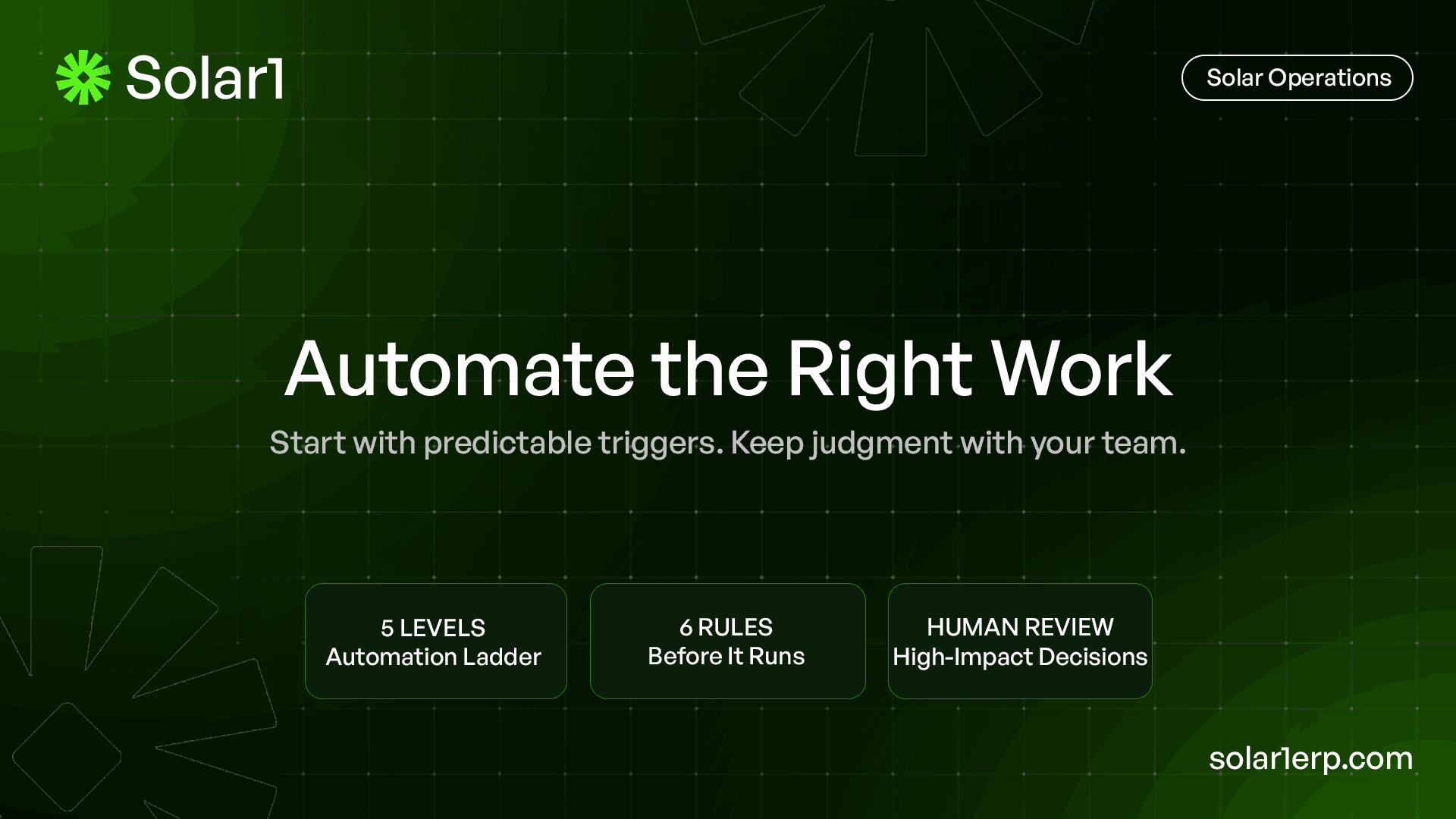
The five levels below are a practical operating framework, not an industry standard: surface, route, validate, execute, and decide. The higher the level, the more expensive a bad rule can become.
| Level | Example | Typical risk | Start here? |
|---|---|---|---|
| Surface | Permit follow-up is due | Low | Yes |
| Route | Assign correction to permit owner | Low | Yes |
| Validate | Check required closeout evidence | Low to medium | Yes |
| Execute | Mark invoice-ready after verified conditions | Medium | After rules are stable |
| Decide | Choose substitute equipment or interpret a correction | High | Usually keep human |
A reminder that fires one day early is annoying. An automatic equipment substitution that changes the approved electrical design can affect procurement, permitting, installation, cost, and customer commitments.
What should solar companies automate first?
Start with work that is repetitive, high-frequency, rules-based, easy to verify, and easy to reverse if something goes wrong. That usually points to coordination work before judgment work.
1. Follow-up reminders and aging
Permit, inspection, interconnection, PTO, purchasing, customer-document, and receivable follow-ups often depend on dates that already exist.
The automation can watch the date, age the item, remind the named owner, and escalate after the company's own threshold. The employee still decides how to handle the external party or unusual case.
This is stronger than sending a generic "please update status" message. The reminder should identify the exact project, current state, last action, owner, and next required move.
2. Ownership and task routing
A verified event can often determine the next responsible role.
If an AHJ returns a correction, create or reopen the correction work and route it to the responsible permit or design owner. If material is received, notify the project or warehouse workflow that the relevant readiness condition can be checked. If field evidence shows a required milestone is complete, route the item to the next inspection or finance review.
Automation is useful here because it removes the gap between something happened and someone noticed.
3. Completeness and readiness checks
Before an important action, software can check whether required inputs are present.
A permit packet might require the current plan set, project information, engineering documents where applicable, and the other fields the company's submission process expects. An install-readiness gate might check permit status, current plans, material allocation, site access, and project-specific prerequisites.
The system should not invent missing information. It should stop the workflow and show what is missing.
4. Status propagation after verified events
One verified event can affect several views without several people retyping it.
A permit approval can update the permit record, satisfy one install-readiness condition, and make the approval visible to scheduling and project management. A verified design revision can become the current revision used by permitting and procurement. PTO can move closeout and any applicable customer or finance workflow forward.
The important control is that dependent records react to an authoritative event, not to a manually typed summary copied into several trackers.
5. Milestone triggers
Milestones are strong automation candidates when their completion criteria are objective.
A completed survey can open design work after the required survey evidence is present. A verified installation milestone can create inspection or finance work. A completed inspection can open the next utility step. A verified PTO event can initiate closeout, customer handoff, and any applicable billing rule.
The automation should create the next work. It does not need to eliminate every review around the milestone.
How should permit and PTO automation work?
Permit and PTO workflows are good examples because they contain both predictable administration and unpredictable external decisions.
The predictable part can be automated aggressively. Record submission dates. Start aging. Schedule follow-ups. Assign corrections. Check document completeness. Escalate an item that crosses the company's rule. Surface applications with no owner or no next action.
The unpredictable part should stay visible to a person. An AHJ correction may require design or engineering interpretation. A utility response may change the expected path. A customer or equipment change may require a resubmission. An external timeline may be uncertain.
SolarAPP+ shows what structured automation can do
The 2026 SolarAPP+ performance review provides a useful example of automation applied to a well-defined permitting use case.
In 2024, 861 installers submitted 37,393 permits through SolarAPP+. The review found that a typical participating project was permitted and inspected 12 business days sooner than projects using traditional processes, and estimated around 18,400 hours of AHJ staff time saved.
Those are SolarAPP+ results, not Solar1 results. They also do not mean every permitting decision should be automated.
The useful lesson is narrower: when inputs, rules, compliance checks, and exception paths are well defined, automation can remove a large amount of repetitive review. When a project falls outside those rules, the workflow still needs an exception path.
What should not be automated in permit and PTO work?
Do not automatically assume that an old external item is late in the same way as an overdue internal correction. Separate external waiting from internal action.
Do not invent utility completion dates simply because a dashboard wants a forecast. Do not automatically resubmit after a correction unless the required technical and document changes have been verified.
And do not let an automated status change silently release scheduling or material decisions when the underlying permit or equipment scope has changed.
How should invoice milestone automation work?
Finance automation is valuable when it removes the question, "Did the operational event actually happen?"
The safest pattern is to automate invoice readiness before automating invoice issuance.
Suppose a contract allows billing after a defined installation milestone. The field workflow can capture the required evidence. When the completion conditions are verified, the system can mark the billing event invoice-ready and place it in the finance queue with the project, milestone, amount or billing rule, and supporting evidence.
Finance can then review the event without chasing operations for proof.
Why not automatically send every invoice?
Because billing can include contract interpretation, change orders, credits, customer disputes, taxes, financing conditions, approval rules, and exceptions that are not captured by one project status.
Some businesses may eventually automate issuance for tightly defined scenarios. But that should be a later-stage automation with clear rules, approval boundaries, audit history, and a way to stop or reverse the action. The first win is usually making the billing event impossible to miss.
What about procurement, inventory, and install readiness?
Automation can connect material events to project readiness without making technical substitution decisions on its own.
Useful examples include notifying the project when required material arrives, flagging a scheduled job whose allocated equipment is incomplete, surfacing purchase orders that threaten a committed install date, or checking whether the material assigned to a job matches the current approved equipment list.
Choosing a substitute is different. An inverter or other component change can affect design, electrical calculations, permit documents, utility applications, job cost, warranty, and customer scope. The system can show the dependency and route an approval. A qualified person should make the decision when technical or commercial judgment is involved.
Which customer updates can be automated safely?
Customer communication is useful to automate when the event is factual and the message does not require interpretation.
Examples include confirming that a site survey was completed, notifying a customer that a required document is still missing, acknowledging a scheduled appointment, or sending a milestone update after the project record confirms that milestone.
Sensitive updates deserve more care. A permit delay, failed inspection, equipment change, financing issue, customer-caused delay, or missed install commitment may require context. An automatic message can make the situation worse if it sends a technically correct status with the wrong explanation or tone.
A good pattern is to automate the trigger and draft, then require human review for messages that change expectations.
What should stay human in solar operations?
Keep people in control when a decision has material technical, safety, compliance, financial, contractual, or customer consequences and the correct action depends on context.
That includes interpreting unusual AHJ or utility responses, approving significant design changes, choosing equipment substitutions that affect approved scope, handling safety or quality exceptions, approving major change orders, resolving disputes, and deciding how to recover a customer commitment after a serious delay.
Human review is also important when AI is involved. NIST's AI Risk Management Framework notes that human roles and responsibilities in decision-making and oversight should be clearly defined, and that some AI systems may specifically require human oversight.
That principle fits solar operations well: AI can summarize, classify, draft, or recommend, but the company should decide which actions it is allowed to take without approval.
| Workflow | Good automation | Keep human |
|---|---|---|
| Permit follow-up | Aging, reminder, assignment | Interpret unusual correction |
| Design revision | Route review, track version | Approve technical change |
| Procurement | Due-date alerts, allocation checks | Approve material substitution |
| Install readiness | Check defined prerequisites | Override unusual readiness case |
| Billing | Create invoice-ready event | Resolve contract or dispute exception |
| Customer updates | Send verified routine milestone | Explain sensitive delay or changed commitment |
| AI assistance | Summarize, draft, classify | Approve high-impact external action |
Give every automation an automation contract
Before turning on a workflow, write down six things. This prevents the automation from becoming a hidden set of assumptions that only the software administrator understands.
1. Trigger
What exact event starts the automation? "Permit changed" is vague. "Permit record moved to correction-required after the AHJ response was attached" is much clearer.
2. Preconditions
What must already be true before the action is allowed? For an invoice-ready trigger, required field evidence may need to exist. For install readiness, current plans, permit conditions, and material allocation may need to be confirmed.
3. Action
What exactly will the system do? Create a task. Change a readiness flag. Notify an owner. Route an approval. Prepare an invoice-ready event. Avoid broad actions such as "move project forward" unless every downstream effect is defined.
4. Proof
What record proves the trigger and action were valid? A permit approval document, signed field checklist, inspection result, material receipt, customer approval, or another source record should support important state changes.
5. Exception route
What happens when the automation cannot safely finish? The item should not disappear into an error log. It needs a named queue or owner, a reason code, and enough context for a person to resolve it.
6. Reversal and audit trail
Can the action be corrected if the source information changes? The company should be able to see what the automation changed, when it changed, which rule ran, and what happened afterward. Important actions should not become irreversible just because they were automatic.
How do you decide whether a workflow is ready for automation?
Use an automation readiness test before discussing vendors, AI, APIs, or custom rules.
A workflow is a strong candidate when the team can answer yes to most of these questions: Does it have a clear trigger? Are the required inputs structured? Is the normal next action unambiguous? Can success be verified? Can exceptions be detected? Is there a named human owner for exceptions? Can the action be reversed or corrected?
If the team argues about the answers, improve the process first.
The strongest automation projects often begin by discovering that the workflow is not ready to automate yet. That is useful information. It prevents the company from encoding a bad process into software.
How should solar companies measure automation value?
Do not measure success only by the number of automated workflows. Track whether the automation removes manual touches without increasing exceptions, rework, or hidden errors.
Useful measures include successful automated actions, exception rate, manual interventions per project, time from trigger to next owner, overdue items, reversal rate, and downstream errors linked to automated actions.
An illustrative example
Suppose 50 active projects each create four routine follow-up events in a month, and each manual follow-up takes about three minutes to find the record, write the reminder, and record the action.
50 × 4 × 3 minutes = 600 minutes, or 10 person-hours per month.
If a rule can reliably create those reminders and route them to the correct owner, most of that coordination time can be removed. This is an example calculation, not an industry benchmark.
But the automation is only a win if it does not create a new problem. If the reminders routinely go to the wrong owner or use stale project data, the time saved on sending them can be lost in correction work.
Should AI run solar operations automations?
Use AI where uncertainty is acceptable and a person can verify the result. Use deterministic rules where the business already knows the exact condition and exact action.
For example, a rules engine is usually better for "when this verified milestone occurs, create this task." AI may be useful for summarizing a long correction letter, classifying an incoming issue, drafting a customer update, or helping a coordinator find relevant project history.
The mistake is using AI to make a workflow look advanced when a simple rule would be more transparent and reliable. For higher-impact AI actions, define the human approval point, the information the reviewer must see, and what the system is prohibited from doing autonomously.
In what order should a solar company automate operations?
Do not launch ten automations at once. Build confidence from low-risk, high-frequency work.
A practical order is to surface overdue work, route routine next actions, validate required inputs, trigger downstream work after verified milestones, automate low-risk external communication, expand execution after exception rates are understood, and keep judgment-heavy decisions behind approval.
Run the workflow long enough to see the exceptions. Fix the rule. Then move to the next one. This creates automation the team can actually trust instead of an impressive-looking set of triggers nobody understands.
How is Solar1 being designed around practical automation?
Solar1 is being built as a complete solar-specific ERP for installers and EPC companies. Its product direction is to connect customer, project, design, permitting, interconnection, procurement, inventory, field, workforce, finance, PTO, service, warranty, and management records so automations can react to the same underlying business events.
The intended philosophy is simple: automate predictable coordination, preserve evidence, surface exceptions, and keep accountable people in the decisions that need judgment.
That can mean a permit correction creating the right follow-up work, a verified design change reaching the records that depend on it, material events affecting readiness, field milestones creating finance or inspection work, and PTO moving the project into the appropriate closeout path.
Solar1 is still under development, so this describes the operating model the product is being designed around. It does not mean every trigger, automation, AI-assisted action, approval flow, or exception workflow described here is currently production-ready.
Automate the right work before you automate more work
The goal of solar process automation is not to remove humans from the project. It is to remove the routine coordination that keeps humans from doing the work that actually needs them.
Start with one workflow. Define the trigger. Define what must be true. Define the exact action. Define proof, exceptions, and reversal. Then automate the normal path and watch what falls outside it.
If the company cannot write those rules clearly, the process is telling you something important: it is not ready for more automation yet.
Use the Automation Readiness Checklist to score the next workflow before building a trigger or buying another automation tool.
Steps
- Choose one repetitive workflow
Start with a high-frequency process such as permit follow-up, ownership routing, readiness checks, or milestone-triggered work.
- Define the trigger
Write the exact event that starts the automation and identify the authoritative record that proves it happened.
- List the preconditions
Specify the data, approvals, documents, and readiness conditions that must exist before the automated action is allowed.
- Define one exact action
State what the system will create, assign, change, notify, or route without using vague instructions such as move the project forward.
- Create the exception route
Send unsafe or incomplete cases to a named human owner with the reason and context needed to resolve them.
- Add proof and reversal
Preserve evidence for important state changes and make sure the action can be corrected when the source information changes.
- Measure the exception rate
Track successful actions, manual interventions, errors, reversals, and time saved before expanding the automation.
- Move up the automation ladder carefully
Expand from surfacing and routing into validation and execution only after the team trusts the data and understands the exceptions.
Frequently asked questions
What solar processes should be automated first?
Start with repetitive, rules-based coordination such as reminders, aging, task routing, completeness checks, and milestone-triggered next steps. These are easier to verify and reverse than technical, financial, or customer decisions that depend on context.
What should a solar company not automate?
Keep human judgment around unusual AHJ or utility responses, significant design changes, equipment substitutions, safety and quality exceptions, disputed billing, major change orders, and sensitive customer commitments. Software can surface the decision and collect the evidence without making the decision itself.
How do I know a solar workflow is ready for automation?
The workflow should have a clear trigger, structured inputs, an unambiguous normal action, a way to verify success, detectable exceptions, a named exception owner, and a reversal path. If the team cannot agree on those elements, standardize the process before automating it.
Should permit and PTO follow-up be automated?
Routine permit and PTO administration is a strong automation candidate. Aging, reminders, ownership, completeness checks, and escalation can be automated, while interpretation of corrections, utility exceptions, scope changes, and uncertain timelines should remain visible to a person.
Should solar companies use AI or rules for workflow automation?
Use deterministic rules when the trigger and next action are already known. AI is better suited to tasks such as summarizing, drafting, classification, and recommendation where a person can verify the result before a higher-impact action occurs.
How should solar companies measure automation ROI?
Measure manual touches removed, trigger-to-owner time, overdue work, exception rate, reversals, and downstream errors, not just how many workflows are automated. A workflow that saves clicks but creates more rework is not a successful automation.